A reverse proxy is a critical component of modern web infrastructure, playing a central role in performance, security, scalability, and reliability. As websites, applications, and APIs grow in complexity and traffic volume, managing incoming requests efficiently becomes essential. This is where a reverse proxy comes in.
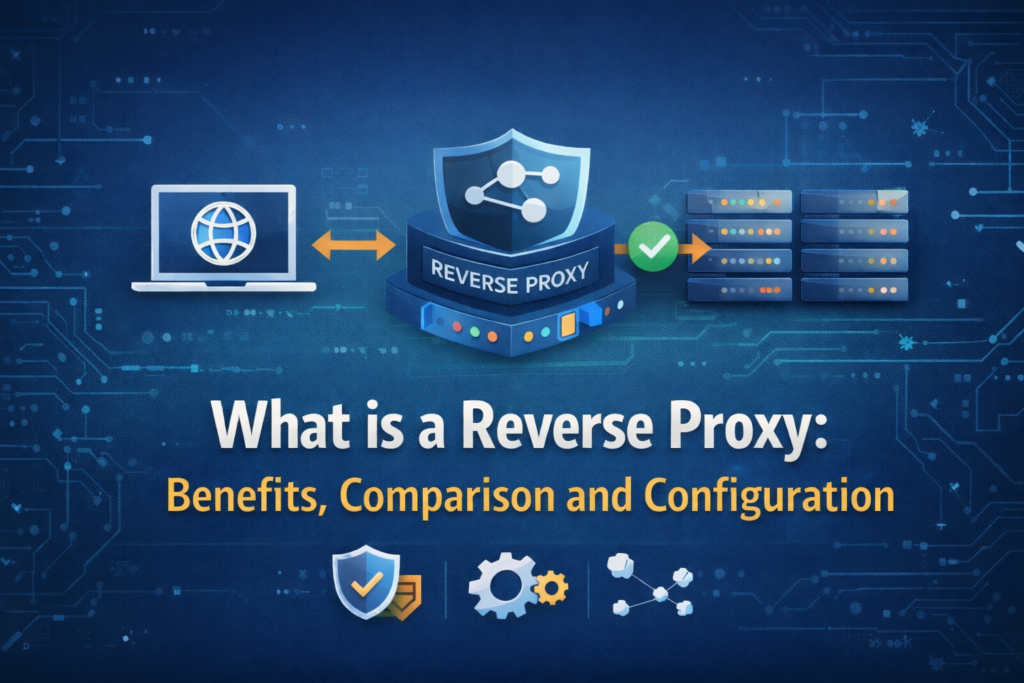
In this article, we will explore what a reverse proxy is, how it works, and why organizations rely on it to protect and optimize their systems. We will break down its core use cases, examine the key benefits of a reverse proxy, and compare it with related technologies such as forward proxies, load balancers, and API gateways. Finally, we will walk through how to configure a reverse proxy, including a practical guide for setting one up in a homelab environment.
What is a reverse proxy?
Reverse proxy definition:
A reverse proxy is a server that sits between clients (such as browsers or mobile apps) and backend servers, intercepting incoming requests and forwarding them to the appropriate origin server. Instead of clients communicating directly with application servers, they interact with the reverse proxy, which acts as an intermediary.
Unlike a traditional proxy that represents the client, a reverse proxy represents the server side. To the client, the reverse proxy appears as the actual website or service, while the backend infrastructure remains hidden.
Some of the main qualities of a reverse proxy include:
- Acting as a single entry point for multiple backend servers
- Enhancing security by masking server identities
- Improving performance through caching and compression
- Enabling scalability via traffic distribution
How does a reverse proxy work?
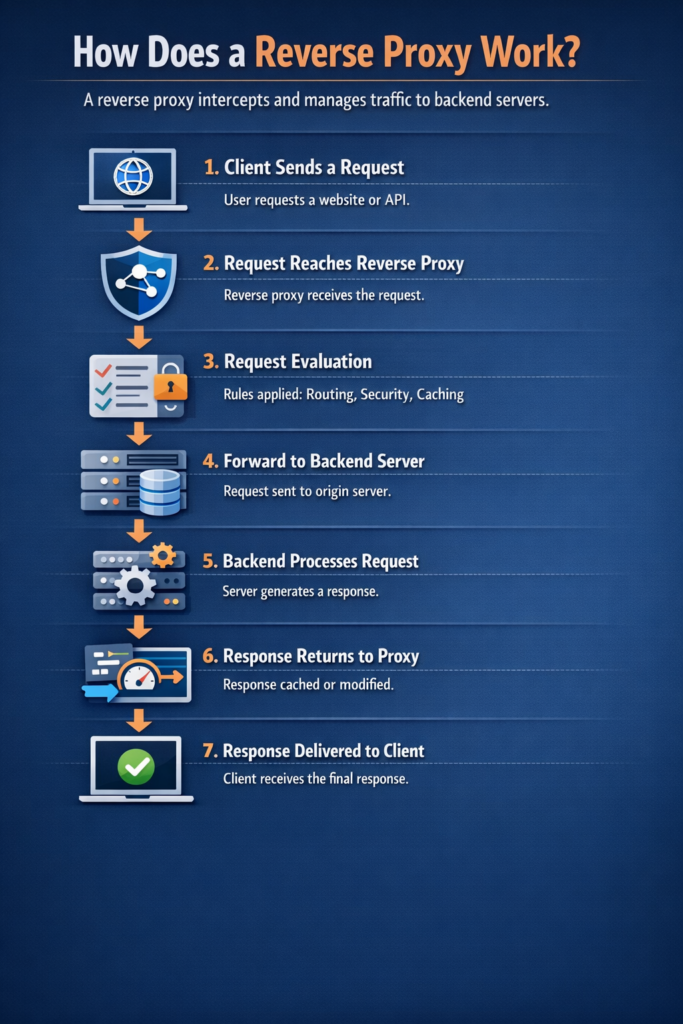
A reverse proxy works by intercepting incoming traffic and managing how requests are routed to backend services. The process can be broken down into clear steps.
Step-by-step process
- Client sends a request
A user’s browser requests a website or API endpoint. - Request reaches the reverse proxy
The reverse proxy receives the request instead of the backend server. - Request evaluation
The reverse proxy applies rules such as routing logic, security filters, authentication, or caching checks. - Forwarding to backend server
The request is sent to the appropriate origin server based on configuration. - Backend processes the request
The server generates a response. - Response returns to the reverse proxy
The reverse proxy may cache, compress, or modify the response. - Response delivered to the client
The client receives the final response, unaware of the backend architecture.
What is a reverse proxy used for?
A reverse proxy is used across many industries and technical environments to solve real-world problems.
Common areas of use are discussed below.
1. Website performance optimization. Reverse proxies cache static content such as images, CSS, and JavaScript, reducing server load and speeding up page delivery.
Example. A high-traffic eCommerce website uses a reverse proxy to cache product images and landing pages.
2. Security and protection. Reverse proxies protect backend servers from direct exposure, reducing attack surfaces and blocking malicious traffic.
Example. A company places a reverse proxy in front of its application servers to mitigate DDoS attacks.
3. Load distribution. Reverse proxies can route traffic across multiple servers, improving availability and uptime.
Example. A SaaS platform distributes user requests across multiple application instances.
4. SSL termination. The reverse proxy handles HTTPS encryption, reducing the computational load on backend servers.
Example. A reverse proxy manages SSL certificates and forwards decrypted traffic internally.
5. API management. Reverse proxies provide routing, rate limiting, and authentication for APIs.
Example. A fintech company uses a reverse proxy to control access to internal APIs.
What are the benefits of reverse proxy?
A reverse proxy provides a wide range of benefits that go beyond simple traffic forwarding. By acting as an intelligent intermediary between clients and backend servers, it improves security, performance, scalability, reliability, and operational efficiency. Below are the core benefits of a reverse proxy, explained in a clear and structured way.
1. Enhanced security for backend servers
Reverse proxy improves security by preventing direct access to backend servers, effectively hiding their IP addresses and internal architecture from the public internet. This reduces the attack surface and allows the reverse proxy to filter malicious traffic, block suspicious requests, and enforce security policies before requests reach the application.
2. Improved performance and faster response times
Reverse proxy improves performance by caching content, compressing responses, and optimizing traffic delivery. By serving frequently requested resources directly from cache and reducing backend workload, it significantly lowers latency and enhances user experience, especially during high-traffic periods.
3. Increased scalability and traffic management
Reverse proxy enables scalability by efficiently distributing incoming traffic across multiple backend servers. This allows applications to handle growing user demand without service degradation and makes it easy to add or remove servers as traffic patterns change.
4. Centralized SSL/TLS termination
Reverse proxy simplifies encryption by handling SSL/TLS termination in a single location. This reduces computational overhead on backend servers and centralizes certificate management, making it easier to maintain secure HTTPS connections across all services.
5. Higher availability and fault tolerance
Reverse proxy improves availability by detecting server failures and routing traffic to healthy backends. If a server becomes unavailable, the reverse proxy ensures uninterrupted service by automatically redirecting requests, minimizing downtime and improving reliability.
6. Protection against DDoS and application-layer attacks
Reverse proxy helps mitigate DDoS attacks by absorbing, filtering, and rate-limiting excessive traffic before it reaches origin servers. It can also block application-layer threats such as SQL injection and cross-site scripting (XSS), acting as an additional defensive layer.
7. Global traffic optimization and geo-based routing
Reverse proxy improves global performance by routing users to the nearest or best-performing server based on location or network conditions. This reduces latency for international users and ensures consistent performance across regions.
8. Improved visibility, monitoring, and logging
Reverse proxy provides centralized visibility by logging all incoming requests and responses. This enables better traffic analysis, performance monitoring, and early detection of anomalies or security incidents.
9. Simplified backend maintenance and updates
Reverse proxy enables seamless maintenance by allowing backend servers to be updated, replaced, or restarted without affecting users. Traffic can be rerouted or temporarily handled by cached responses, reducing service disruption.
10. Protocol compatibility and future-proofing
Reverse proxy supports protocol translation by allowing modern client protocols (such as HTTP/2 or HTTP/3) while maintaining compatibility with legacy backend systems. This ensures long-term flexibility without requiring immediate backend upgrades.
Reverse proxy comparison
The following sections compare a reverse proxy with related technologies to clarify differences and appropriate use cases.
Proxy vs reverse proxy
A proxy and a reverse proxy both act as intermediaries, but they serve different sides of the connection.
| Feature | Proxy | Reverse Proxy |
| Represents | Client | Server |
| Hides | Client identity | Server identity |
| Typical use | Anonymity, access control | Security, performance |
| Placement | Client-side | Server-side |
Forward proxy vs reverse proxy
A forward proxy controls outbound traffic, while a reverse proxy manages inbound traffic.
| Feature | Forward Proxy | Reverse Proxy |
| Traffic direction | Outgoing | Incoming |
| Primary role | Client control | Server optimization |
| Common users | Individuals, enterprises | Websites, APIs |
| Visibility | Known to client | Transparent to client |
Reverse proxy vs load balancer
While load balancing is a function, a reverse proxy offers broader capabilities.
| Feature | Reverse Proxy | Load Balancer |
| Traffic routing | Yes | Yes |
| Caching | Yes | Limited |
| Security features | Advanced | Basic |
| SSL termination | Yes | Yes |
| Scope | Broad | Narrow |
API gateway vs reverse proxy
An API gateway is specialized for APIs, while a reverse proxy is more general-purpose.
| Feature | API Gateway | Reverse Proxy |
| API management | Advanced | Basic |
| Rate limiting | Yes | Optional |
| Protocol translation | Yes | Limited |
| Use case | Microservices | Web & API traffic |
How to configure a reverse proxy?
Configuring a reverse proxy involves setting rules that define how traffic is handled. Reverse proxies can be configured using:
- Web servers (Nginx, Apache)
- Dedicated reverse proxy software
- Container-based solutions
- Cloud-based reverse proxy services
The configuration generally includes:
- Defining backend servers
- Setting routing rules
- Enabling SSL
- Configuring caching and security policies
How to configure a reverse proxy in a homelab?
Setting up a reverse proxy in a homelab is a practical way to learn and manage self-hosted services.
Step-by-step homelab configuration
- Choose a reverse proxy
Popular options include Nginx, Traefik, and Caddy. - Install the reverse proxy
Install it on a dedicated VM, server, or container. - Define backend services
Map domains or paths to internal services. - Configure routing rules
Specify how requests are forwarded. - Enable HTTPS
Use self-signed or automated certificates. - Test configuration
Verify that traffic reaches the correct services.
Homelab consideration
- Network segmentation
- Resource limitations
- Certificate automation
- Security rules and firewall settings
Frequently Asked Questions (FAQs)
Why is it called a reverse proxy?
It is called a reverse proxy because it performs the opposite role of a traditional proxy. Instead of acting on behalf of the client, it acts on behalf of the server, managing inbound traffic.
Is VPN a reverse proxy?
No, a VPN is not a reverse proxy.
A VPN creates an encrypted tunnel between a client and a network, while a reverse proxy manages and routes application-level traffic between clients and servers.
What is a reverse proxy cache?
A reverse proxy cache stores copies of server responses and serves them directly to clients, reducing backend load and improving response times.