If you’ve ever wondered how companies track competitor prices, monitor search rankings, or collect large amounts of online data automatically, the answer is usually web scraping. In this guide, you’ll learn what web scraping is, how it works, what type of data it extracts, what web scraping is used for, and how tools, programming languages, parsing techniques, and proxies all fit together. We’ll also explain what web scraping is in Python, how to choose the best web scraping tool, and what is the best proxy for web scraping.
By the end of this article, you’ll understand not just the definition of web scraping, but the full ecosystem around it.
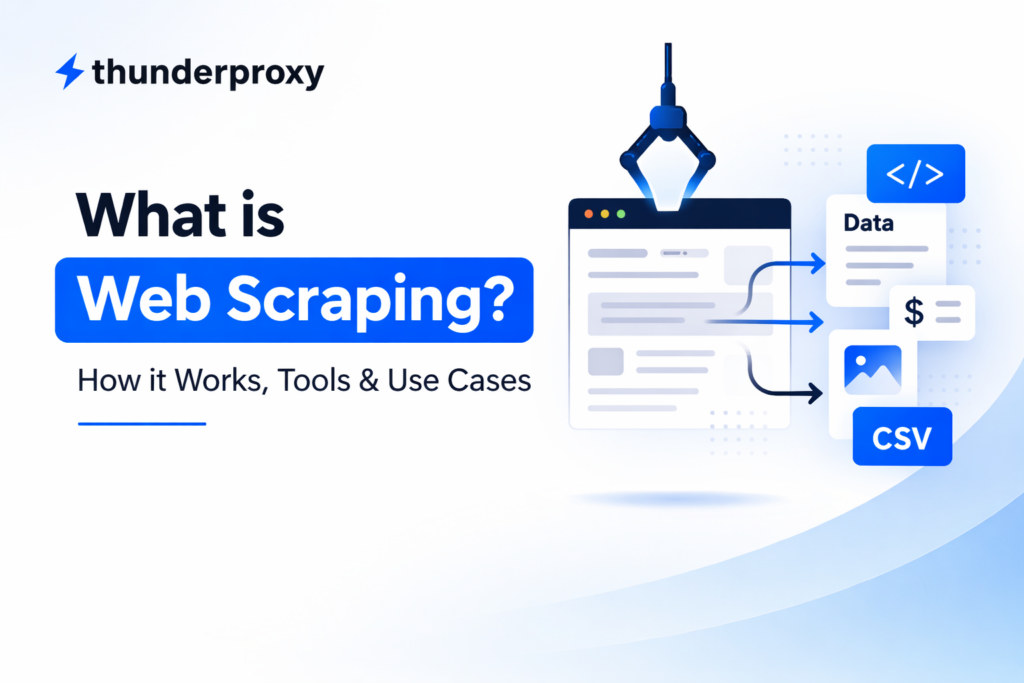
What is web scraping and how it works
Web scraping is the automated process of collecting publicly available data from websites. Instead of manually copying information from web pages, a script or software tool sends requests to websites, retrieves their content, and extracts specific data elements.
At its core, web scraping follows a structured technical workflow.
step 1: sending a request to a website
Every scraping process starts with an HTTP request. A scraper sends a request to a webpage URL, just like a browser does when you open a site. The server then responds with HTML, JSON, or other structured data formats.
step 2: receiving and reading the response
Once the server responds, the scraper receives the page source code. For static sites, this is usually raw HTML. For modern applications, it may include dynamic data loaded via APIs.
step 3: parsing and extracting the data
After receiving the content, the scraper parses it. Parsing means analyzing the HTML structure to identify specific elements such as product names, prices, headings, or links. We’ll explain more about what parsing in web scraping means later in this article.
step 4: storing and structuring the data
Finally, the extracted data is converted into structured formats like CSV, Excel, JSON, or databases so it can be analyzed or used in applications.
This entire flow explains what web scraping is and how it works in practice.
What kind of data web scraping is used to extract?
When asking “web scraping is used to extract what type of data?”, the answer depends on industry context — but fundamentally, scraping extracts publicly available web content that follows a repeatable structure. The web is filled with semi-structured information, and scraping turns that into fully structured datasets.
Businesses, researchers, and developers use scraping to collect large volumes of data efficiently, particularly when APIs are unavailable or limited.
Ecommerce and product data
One of the most common uses of web scraping is extracting product information from ecommerce platforms. Businesses collect:
- Product names
- Prices
- Discount rates
- Reviews and ratings
- Availability status
This data supports pricing strategies and competitive intelligence.
Search engine results and seo data
SEO professionals scrape search engine results to track:
- Keyword rankings
- Featured snippets
- Local pack results
- Competitor domains
Search data scraping supports performance analysis and campaign optimization.
Financial and market intelligence data
Investors and analysts scrape:
- Stock prices
- Cryptocurrency values
- Market indices
- Economic indicators
Automating this process allows real-time dashboards and predictive modeling.
Business directories and lead data
Public company directories and listings are scraped for:
- Company names
- Phone numbers
- Email addresses
- Physical locations
This supports B2B marketing and outreach.
In short, web scraping extracts structured datasets from unstructured web pages.
What is web scraping used for?
Understanding what web scraping is used for requires examining how organizations apply it operationally. Web scraping is rarely an end in itself; it powers decision-making systems and automation workflows.
At scale, scraping becomes part of business intelligence infrastructure rather than a simple technical task.
Competitive price monitoring
Companies track competitor pricing strategies automatically instead of manually checking websites. Scraping allows businesses to adjust prices dynamically, react to promotions, and maintain competitive positioning.
Market research and trend analysis
By scraping reviews, forums, and product feedback pages, businesses analyze customer sentiment and identify emerging trends. This data feeds into predictive analytics and product development strategies.
SEO performance tracking
Digital agencies scrape search engine results to monitor keyword positions and competitor movements. This allows data-driven SEO decisions.
Real estate market analysis
Real estate platforms scrape listings to analyze price fluctuations, availability, and neighborhood trends.
Content aggregation and monitoring
News aggregators, job platforms, and comparison websites rely on scraping to gather and update content from multiple sources continuously.
Web scraping is therefore a backbone technology for automation, analytics, and digital intelligence.
What is web scraping in python
Python is widely considered the best language for web scraping because of its readability, flexibility, and powerful ecosystem. When people ask what web scraping is in Python, they are referring to using Python libraries to automate the scraping workflow described earlier.
Python simplifies every stage of scraping: sending requests, parsing HTML, handling errors, and structuring data.
Core python scraping libraries
Requests handle HTTP communication. Beautiful Soup parses HTML and allows element targeting. Scrapy provides a full scraping framework for large-scale crawling. Selenium automates real browsers for JavaScript-heavy websites.
These tools allow developers to build everything from small scripts to enterprise-level scraping systems. If you want a practical walkthrough that combines Selenium with Python in a real scraping setup, check out our detailed guide on How to use Python for web scraping, where we explain step-by-step implementation and best practices.
However, as scraping scales, websites may block repeated requests from a single IP address. That is why infrastructure becomes important.
To maintain stable and scalable scraping operations, many developers use reliable proxies that distribute requests across multiple IP addresses and reduce the risk of blocking.
What is the best language for web scraping?
Different programming languages offer different strengths for web scraping:
- Python: Most popular due to excellent libraries (Scrapy, BeautifulSoup, Requests).
- JavaScript/Node.js: Good for asynchronous requests and dynamic or SPA sites.
- Go: Known for performance and concurrency.
- Java/C#: Often used in enterprise environments.
For most beginners and many professionals, Python remains the strongest choice due to its simplicity and tool ecosystem.
What is the best web scraping tool?
There is no universal “best” web scraping tool. The right choice depends on scale, technical expertise, and target website complexity.
For beginners or smaller projects, combining Requests and Beautiful Soup provides flexibility and control. For larger-scale projects that involve crawling multiple pages automatically, Scrapy offers structured pipelines and performance efficiency.
When dealing with heavily dynamic websites that rely on JavaScript rendering, Selenium or headless browsers become necessary.
The best web scraping tool is the one aligned with your technical requirements and scalability goals.
What is the best proxy for web scraping?
As scraping volume increases, IP management becomes critical. Websites often detect and limit repeated automated requests. Proxies solve this problem by routing requests through different IP addresses.
The best proxy for web scraping depends on use case:
- Datacenter proxies offer speed and affordability for high-volume scraping.
- Residential proxies provide higher anonymity and lower detection risk.
- Rotating proxies automatically change IP addresses between requests.
- Geo-targeted proxies allow region-specific data collection.
Choosing the right proxy strategy ensures scraping stability, geographic flexibility, and long-term reliability.